Precision Forestry Market: Charting the Next Era of Sustainable Forest Management
.webp)
Forests are no longer managed solely with maps and manual labor—they are increasingly optimized using satellites, sensors, and software. The Precision Forestry Market is rapidly emerging as a transformative force in sustainable land use and resource planning. As climate change, rising timber demand, and ecological accountability converge, industries are embracing data-driven forestry solutions. This market is gaining momentum due to advancements in remote sensing, increased environmental regulation, and a rising need to maximize yield without degrading natural ecosystems. For forestry companies, governments, and conservationists alike, precision tools are not just innovative—they’re indispensable.
2. Market Size and Growth Potential
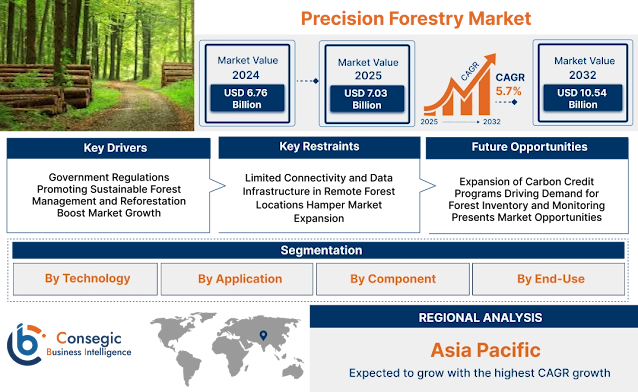
The Precision Forestry Market was valued at USD 6.76 billion in 2024 and is expected to reach USD 7.03 billion in 2025. By 2032, it is projected to surge to USD 10.54 billion, growing at a compound annual growth rate (CAGR) of 5.7% from 2025 to 2032.
This growth is indicative of increased adoption of geospatial technologies and automation in forestry operations. As the global forestry sector seeks to improve yield, reduce waste, and meet regulatory compliance, investments in smart solutions are on the rise. The forecast suggests significant momentum across commercial plantations, government programs, and industrial forestry zones worldwide.
3. What’s Driving the Market?
-
Technological Innovations: Tools like LiDAR, GIS, drones, and remote sensing are enabling real-time insights, site-specific interventions, and better inventory management.
-
Industrial Demand for Timber: Rising global construction and paper product demands are putting pressure on forest operations to be more efficient and sustainable.
-
Environmental Regulations: Policy mandates are increasingly requiring sustainable harvesting, carbon monitoring, and biodiversity protection.
-
Climate Resilience and Carbon Offsetting: Forests play a vital role in carbon sequestration, driving investment in data-driven approaches for fire prevention, habitat management, and emissions tracking.
4. Drivers, Restraints, and Opportunities
-
Drivers:
-
Integration of AI, IoT, and geospatial analytics
-
Supportive government reforestation programs
-
Demand for real-time forestry data and automation
-
-
Restraints:
-
High initial capital investment
-
Limited digital infrastructure in developing regions
-
Lack of skilled personnel to operate precision tools
-
-
Opportunities:
-
Expansion into Asia-Pacific and Latin America, where forest land is abundant but under-digitized
-
Rise of carbon credit programs supporting sustainable logging
-
Growth in subscription-based forestry management platforms
-
5. Market Segmentation
By Technology
-
Remote Sensing
-
GIS (Geographic Information Systems)
-
GPS (Global Positioning Systems)
-
Telematics
-
Drones/UAVs
-
LiDAR
-
Others
By Application
-
Forest Management and Planning
-
Precision Silviculture
-
Wildlife Habitat Management
-
Carbon Sequestration
-
Genetics and Nurseries
-
Fire Management
-
Harvesting Management
-
Inventory & Logistics Management
By Component
-
Hardware
-
Software
-
Services
By End-Use
-
Industrial Forests
-
Commercial Plantations
-
Government & Community Forestry
-
Academic & Research Institutes
-
Forestry Contractors
-
Others
This segmentation enables analysts and stakeholders to evaluate the market from various operational, technological, and customer perspectives—revealing where investment, demand, and innovation are most concentrated.
6. Segmental Opportunities
-
Largest Subsegment: Forest Management and Planning dominates due to its broad applicability in sustainable logging, land mapping, and biodiversity protection. It holds the largest share by volume and revenue.
-
Fastest-Growing Subsegment: Drones/UAVs are witnessing the highest growth rate. Their affordability, accessibility, and ability to perform aerial surveys, monitor forest health, and track growth patterns are key growth drivers.
7. Regional Trends
-
North America: Leading in tech adoption, this region leverages advanced mapping, fire risk mitigation systems, and digital silviculture to manage vast commercial forests. Public-private partnerships also play a key role.
-
Asia-Pacific: The fastest-growing region due to increasing afforestation initiatives, rising timber exports, and digitization of forest-based economies in countries like China, India, and Indonesia.
-
Europe: A front-runner in eco-conscious forestry. EU regulations and sustainability goals drive demand for data-rich tools to monitor emissions, wildlife corridors, and sustainable harvesting.
-
Latin America: Countries with extensive forest cover such as Brazil and Chile are investing in satellite tracking and habitat conservation. The region’s growth is tied to global wood exports and deforestation control.
-
Middle East & Africa: While still emerging, the region is exploring forestry tech for reforestation, desert greening, and sustainable land-use planning, supported by international environmental agencies.
8. Challenges and Innovation
Key Challenges:
-
Upfront equipment costs for smaller forestry operators
-
Inadequate training for data interpretation
-
Infrastructure limitations in rural and remote areas
Innovations Making a Difference:
-
Modular, plug-and-play sensor systems reducing setup complexity
-
Cloud-based forestry platforms enabling remote analytics
-
AI-enabled risk prediction models for fire outbreaks and disease tracking
-
Blockchain for timber traceability, ensuring legal and sustainable sourcing
9. Top Key Players in Precision Forestry Market Market are:
Deere & Company (USA)
Trimble Inc. (USA)
Raven Industries (USA)
Tigercat International Inc. (Canada)
Ponsse Plc (Finland)
Komatsu Forest AB (Sweden)
Treemetrics Ltd. (Ireland)
Rottne Industri AB (Sweden)
Ecolog (Sweden)
Sampo Rosenlew Ltd. (Finland)
10. Outlook: What’s Ahead?
Precision forestry is shifting from niche innovation to mainstream necessity. As forests become central to both ecological sustainability and economic productivity, precision tools are evolving into business-critical assets. The future lies in integrated ecosystems—blending AI, automation, and sustainability.
In the next decade, the market will emphasize:
-
Greater customization for regional forestry practices
-
Digital twins of forest lands for simulation and planning
-
Seamless data integration across platforms and teams
For forward-thinking businesses and policy planners, precision forestry represents both a moral imperative and a commercial opportunity.
11. FAQs Section
Q1: What is the current market size and future forecast for the Precision Forestry Market Market?
A1: The market was valued at USD 6.76 billion in 2024 and is projected to reach USD 10.54 billion by 2032, growing at a CAGR of 5.7%.
Q2: Which segment leads the market?
A2: Forest Management and Planning leads the market due to its wide applications across both public and private forestry operations.
Q3: Which region shows the fastest growth?
A3: Asia-Pacific is the fastest-growing region, driven by reforestation efforts and increasing adoption of digital forestry tools.
Q4: What innovations are driving the market forward?
A4: Drones, AI-based analytics, cloud platforms, and blockchain-enabled traceability are some of the key innovations transforming this market.
.webp)
Comments
Post a Comment